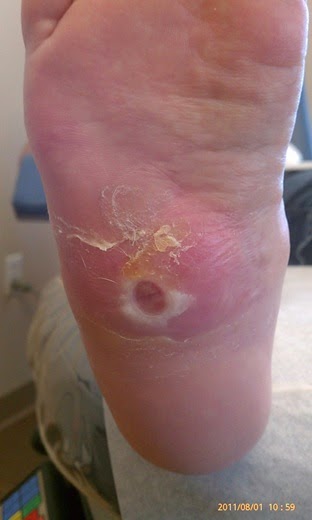
A story on why Diabetic Foot Ulcers continue to recur and the painful truth on why it continues to happen.
Dear Patient,
You are not alone. After the last 17 years in private practice and the 4 different wound care centers I have seen patients, there are literally thousands of people just like you. I have personally met many people just like you. They all have some pretty similar stories. There is the patient who was first seen by his primary care physician who saw the wound on the bottom of your foot and your doctor decided to try to treat it. Maybe the doctor was trying to make your life more convenient, to not have to go to more than one doctor. Or maybe your doctor did not realize the urgency there is to diagnosis and start treatment for these types of wounds. Whatever the reason may be, there was a delay in the care of the wound most likely until you were referred to a foot doctor, or podiatrist. A
Podiatrist is a doctor who is skilled and trained to treat conditions below the knee. After completing 4 years of post graduate training, your podiatrist will most likely have completed a 2 or 3 year surgical training dedicated to the disease processes related to below the knee. Many podiatrist have extensive training in diabetic limb salvage.
Over the last couple of years, I have had many other doctors and patients comment at how good I am at treating the wounded foot. I have worn that hat very proudly, until this past Monday. I was seeing patients at one of the wound care centers that I work at, when I over heard the patient speaking to the nurse and his exact quote was, " This is all of that doctor's fault that I have this wound again!" I immediately got defensive in my own brain. How dare he say that, it's not my fault his ulcer recurred again. He has bad luck, bad protoplasm if it were, I healed him fair and square. He re-ulcerated on his own. I had worked myself up that by the time I had got in the room I was ready to let him have it.
An interesting thing happened when I went in the room. Right away I looked at this man, who I had treated for months and finally healed after he had the problem for about a year before I met him. I can honestly say it took us a good 6 months before he had healed. He had to have IV antibiotics, a special shoe that took pressure off of the area where the wound was located, as well weekly debridements on the wound until he was healed.
Debridement is when the doctor uses an instrument like a surgical blade to remove all of the dead tissue within the wound.
I opened the treatment room door, took a deep breath and then I said,
"I can help heal you again, but I can not cure you!" The patient became very agitated by this news. I will admit that I am very good at giving advice on how to not get another wound. I know that before I discharged this particular patient from the wound care center, that I explained to him how important it is to see a foot doctor regularly. I explained to him that a foot doctor can shave down a callus that could potentially become a wound. I discussed with him the importance of daily foot inspections and for special shoes to offload the problem area. But, I can honestly say, when he heard the words "you are healed" a couple months ago he assumed this was cured.
He was struggling to argue with me, because he knew that we had discussed wearing the diabetic shoes. We discussed all of the preventive measures he should take, but he was healed. He just didn't get it, I could tell by the very confused look on his face. So I blurted out "When my husband had colon cancer in 2015, the doctor cut out the part of his colon that had cancer and for all intensive purposes he was healed and cured. Yes he could have recurrence but for now he is still cured." I explained to the patient that diabetic wounds on the bottom of your foot are a much poorer prognosis than my husbands colon cancer. Most patients are just not aware of the fact that
Diabetes kills more people annually than breast cancer and AIDS combined. American Diabetes Association, 2009. This patient, like the majority of patients with diabetes, do not know that every 20 seconds someone has a non-traumatic amputation as a complication from their diabetes. Armstrong, et al, Diabetes Care 2013
Patients living with diabetes often do not know that 60-70% of those with diabetes will develop peripheral neuropathy, or lose sensation in their feet. Dyck et al. Diabetic Neuropathy 1999. This neuropathy, or lack of sensation is why this patient continues to ulcerate or have an open wound develop. Every time he gets out of bed in the morning to brush his teeth and he doesn't put special shoes on, he starts the road back to ulceration. Every time he decides to get up in the middle of the night to go to the bathroom he starts the pathway back to ulceration. He just doesn't understand, once the skin is healed, it does not make him cured. He will struggle the rest of his life to not be a statistic! Up to 34% of those with diabetes will develop a foot ulcer. Armstrong, Boulton, Bus, New England Journal of Medicine, 2017. More than half of all foot ulcers (wounds) will become infected, requiring hospitalization and 20% of infections result in amputation. Lavery, Armstrong, et al. Diabetes Care 2006
There is a shroud of denial that many of these patients wear. They don't want to hear the words that might just save their limb. I will continue to push and be an advocate for my wounded patients. But if you are diabetic you need to play a role in your care and then it continues into your prevention. It takes so little effort for someone to re-ulcerate. It takes great efforts to stay healed. When this patient re-ulcerated he did not go into remission, there is no current cure for what he has. He has the perfect storm of neuropathy(no sensation on his feet to feel pain), poor bony architecture that causes him to put more pressure in certain spots leaving him vulnerable to developing a callus and ambivalence to the role he has to play in his own care.
So dear patient, if you have just healed from having a wound, you need to do some pretty basic things to keep from having a wound again.
- You have to check your feet everyday
- You have to wear diabetic shoes with inserts that have an offload, to take pressure off of the area where you had a wound before
- You need to see a podiatrist every couple months
- You have to not be in denial that only you can keep you ulcer free.
Number 4 is really the hardest. I liken it to when a Type 2 Diabetic is first told by the doctor that "you need to change your diet, cut out your big carbs like your rice, bread and pasta." But next thing you know there you are in Olive Garden eating your bread sticks and having your pasta. You know you shouldn't be there but you tell yourself tomorrow you will be good. The reality is that the diet, if you try a little harder each day you can move in the right direction. Your feet are not the same! The day after you just healed an ulcer and you do not wear the shoes that offload the area where the ulcer was, you are on the path to re-ulcerating or opening your wound again. I have seen patients on a Friday with a healed toe wound that come back in on a Monday after going to a wedding over the weekend and end up getting a toe amputation from wearing dress shoes that were too tight for eight hours!
So, dear patient, though you actually fall in my favorite patient category to treat, I can not cure you. I have no other part of my profession as a podiatrist that I find more fulfilling than helping someone heal a wound. Especially the people who had a relative like a mother or father that lost a limb, and the patient fears that this is some type of genetic legacy to lose a limb. The technology, advance re-vascularization procedures that the vascular surgeons can perform, the materials available to offload the wounds, the advances in topical medications to help some of these wounds heal were not available years ago. People back in the day would go to the hospital with a toe wound and leave with a below the knee amputation. This is not what typically happens anymore.
Below is a patient who healed a wound in September. He presented back to the office in late December, after being on his feet during the holidays and not in good shoes. The first picture is what he looked like about 3 weeks ago and then yesterday. In 3 weeks of taking pressure off of the area and good local wound care he is almost completely healed. I decided to leave with this image and order because I want patients to know healing is possible, but you have to be willing to accept the responsibility of staying healed and all of the preventive measures that go along with that responsibility.
Sincerely,
Michele McGowan, DPM
Center for Ankle and Foot Care
3190 Citrus Tower Blvd STE A
Clermont, FL 34711


 As surgically trained podiatrists, the Center for Ankle and Foot Care doctors truly
understand the diabetic foot, how ulcers are formed and how to treat
ulcerations. Dr. Michele McGowan was trained in Pittsburgh, Pennsylvania
and was the diabetic foot fellow. "My time as the Diabetic Foot
Fellow encompassed 2 years of surgical training dedicated to the treatment of
the diabetic foot wounds and the complications associated with the wounded
foot, " Dr. McGowan explains. " Sometimes patients waste so
much time being under treated by doctors who do not understand the
pathophysiology and biomechanics of the diabetic foot. There are so many
studies that show the better outcomes are associated with timely intervention
by a skilled physician."
As surgically trained podiatrists, the Center for Ankle and Foot Care doctors truly
understand the diabetic foot, how ulcers are formed and how to treat
ulcerations. Dr. Michele McGowan was trained in Pittsburgh, Pennsylvania
and was the diabetic foot fellow. "My time as the Diabetic Foot
Fellow encompassed 2 years of surgical training dedicated to the treatment of
the diabetic foot wounds and the complications associated with the wounded
foot, " Dr. McGowan explains. " Sometimes patients waste so
much time being under treated by doctors who do not understand the
pathophysiology and biomechanics of the diabetic foot. There are so many
studies that show the better outcomes are associated with timely intervention
by a skilled physician."  " I love helping
patients with wounds get better. There is no other part of my profession
that I enjoy more. It takes a lot of hard work on the doctor and patient
side to help heal a wound. I am a big fan of tough love and make my patients
be an active part of their care. Patients need to know how important it is for
them to be invested in their outcome. Wound care is not a passive patient
treatment, patients come in to our office and if they really want to be healed
we can help them. Sometimes I have to get a patient to a vascular doctor
to restore blood flow, or an infectious disease doctor for IV antibiotics,
sometimes patients have to wear an annoying boot they don't want to wear.
But I take the time to explain all of this to a patient. Sadly, sometimes a
patient comes into the office after delaying care for so long and I have to be
the person who tells them that it is too late for their limb." If
you have been struggling with a wound for a long time on the foot, it is time
to call us at The Center for Ankle and Foot Care and make an appointment with
Dr. McGowan. Call now 352-242-2502.
" I love helping
patients with wounds get better. There is no other part of my profession
that I enjoy more. It takes a lot of hard work on the doctor and patient
side to help heal a wound. I am a big fan of tough love and make my patients
be an active part of their care. Patients need to know how important it is for
them to be invested in their outcome. Wound care is not a passive patient
treatment, patients come in to our office and if they really want to be healed
we can help them. Sometimes I have to get a patient to a vascular doctor
to restore blood flow, or an infectious disease doctor for IV antibiotics,
sometimes patients have to wear an annoying boot they don't want to wear.
But I take the time to explain all of this to a patient. Sadly, sometimes a
patient comes into the office after delaying care for so long and I have to be
the person who tells them that it is too late for their limb." If
you have been struggling with a wound for a long time on the foot, it is time
to call us at The Center for Ankle and Foot Care and make an appointment with
Dr. McGowan. Call now 352-242-2502.