Saturday, February 27, 2016

Cracked dry heels? Get smooth heels now!!!!

We see many patients a day that come into the office for all different types of foot and ankle problems. A very common issue that is mentioned by patients after treating their foot problem is, "Hey doc, what to you recommend for dry, cracked heels or dry skin?" For years I would direct them to their local neighborhood pharmacy with a prescription for 40% Urea cream.  But about two or three years ago I started to have many angry patients who would call the office upset that I would give them a prescription for something so expensive and that was not covered!!! That is right, insurance companies stopped covering this very effective and safe way to get rid of cracked heels and dry skin.  I gave up on this for a while, sending patients to get some junk at the pharmacy that just wasn't as effective.

Over the counter, in the last couple of years, many great new Urea 40% creams have become available without a prescription but are not available in stores.  My favorite, which is available on Amazon is Revitaderm 40. What I love about this product is that, out of all of the creams available on the market for dry cracked heels this one comes with a pleasant odor while still being extremely efficient at making your skin smooth and get rid of dry cracked heels. This product has Chamomile, Tea Tree Oil and Aloe Vera which gives is a great odor.  Many other products seem just oily and a little smelly.

Urea Cream 40 / RevitaDERM - 8oz

I now just direct my patients to Amazon.com to buy the cream. Many times they can get it the next day, with out having to go to the store and hunt around for something you can not find there!  If you go to your local neighborhood pharmacy, the closest they come to this product is 10% Urea creams.  I would say this may be O.K. for areas that you do not bear weight on, but would not be effective for the problem areas like dry cracked heels and thick skin under the ball of the foot.  The 40% Urea creams will be very effective over time to get your heels and problem areas smooth as a baby's bottom:)

If you have really thick skin on the bottom of your feet, a trick I tell my patients about is the following. Before bedtime, place the Reviatderm 40 on the affected foot and (I know this is going to sound really weird) gently, not tight, wrap Saran or cling wrap around the foot and place a clean sock over it and go to sleep, take wrap off in the morning and go about your business.  If you have really bad calluses or thick dry skin you could see a big change in as little as a week doing this daily.

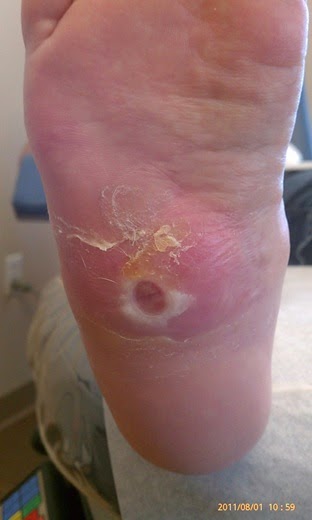
The link below will take you to Amazon for purchasing the RevitaDerm 40 cream.  I can say that I have seen many people have great satisfaction with this product and that is why I am sharing it with you! This product is safe for diabetics as well. Calluses on a diabetic foot can lead to ulceration (open wound) if left to continue to build up.  I consider this product an ounce of well needed prevention on the diabetic foot!

 If you have a foot or ankle problem and would like to learn more, feel free to visit our website at http://centeranklefootcare.com/


Friday, December 11, 2015

ICD-10 Coding for Diabetic wounds, what you as a podiatrist should know.

We are now a 2 full months into the ICD-10 code take over.  In my own practice, I can tell you that my world did not come crumbling down, and claims from all payers are coming in the normal standard fashion.  All of my at risk foot care or diabetic foot care claims have all been clean with no problems. Normal every day tendon injuries like peroneal tendonitis, Achilles tendonitis, posterior tibial tendonitis and plantar fasciitis claims are going through as well with no problems.

The only claims that I had kicked back to me have been my diabetic foot ulcers.  The following is what you need to know to bill a diabetic foot wound correctly:

1.  You will need the diabetic foot code associated with if the person is Type 1 or Type 2 diabetic and has a foot wound

  • E11.621- Type 2 diabetes with foot ulcer
  • E10.621- Type 1 diabetes with foot ulcer
2.  You will need the code for the specificity of the site, laterality, and depth.  L97.5 is a non pressure wound other part of the foot(toes) and L97.4 is a non pressure wound on the heel or midfoot adding a 1 or 2 gives the laterality, right or left foot respectively. But the addition of depth is included in the codes below to give you the most specificity for these codes to be covered and paid. 

If your wound is on the right side you will be using one of the codes below for a diabetic foot wound on the toes:
  • L97.511-  Right foot non pressure ulcer with breakdown of skin
  • L97.512-  Right foot non pressure ulcer with fat layer exposed
  • L97.513-  Right foot non pressure ulcer with necrosis of muscle
  • L97.514-  Right foot non pressure ulcer with necrosis of bone


If your wound is on the left side you will be using one of the codes below for a diabetic foot wound on the toes:
  • L97.521-  Left foot non pressure ulcer with breakdown of skin
  • L97.522-  Left foot non pressure ulcer with fat layer exposed
  • L97.523-  Left foot non pressure ulcer with necrosis of muscle
  • L97.524-  Left foot non pressure ulcer with necrosis of bone
If your wound is on the right side you will be using one of the codes below for a diabetic foot wound on the heel or midfoot:
  • L97.411-  Right foot non pressure ulcer with breakdown of skin
  • L97.412-  Right foot non pressure ulcer with fat layer exposed
  • L97.413-  Right foot non pressure ulcer with necrosis of muscle
  • L97.414-  Right foot non pressure ulcer with necrosis of bone
If your wound is on the left side you will be using one of the codes below for a diabetic foot wound on the heel or midfoot:
  • L97.421-  Left foot non pressure ulcer with breakdown of skin
  • L97.422-  Left foot non pressure ulcer with fat layer exposed
  • L97.423-  Left foot non pressure ulcer with necrosis of muscle
  • L97.424-  Left foot non pressure ulcer with necrosis of bone
3.  Most of our diabetic patients that have foot ulcers also have some degree of polyneuropathy and coding for that would get you to the highest level of specificity using one of the following codes linking the Type 1 or 2 diabetes with the polyneuropathy:

  • E11.42- Type 2 diabetes with diabetic polyneuropathy
  • E10.42- Type 1 diabetes with diabetic polyneuropathy
For example, from the information above, if you had a Type 2 diabetic with a foot ulcer on their left heel with exposed bone and they have polyneuropathy the only three codes you need to be reimbursed with the correct documentation, would be the following:
  • E11.621
  • L97.424
  • E11.42
This again is pretty simple when you have it all in front of you and organized, As it is almost impossible to have all of these codes on your superbill or encounter form, it may be a great idea to have these codes on a cheat sheet in each treatment room.  It will save you time, not having to scroll through your EMR for the codes, especially of you see high volume of diabetic wounds. 

I hope this helps makes your life a little easier in the ICD-10 new world of billing. I know in my practice I see a lot of diabetic wounds so I was happy to see these codes were not terribly convoluted. If you do not have a "superbill" we have a quick reference sheet, for what we see as podiatrist most common diagnosis, available at our website. For $75 we will email it to you with our metatarsal fracture cheat sheet and our power point on billing diabetic foot care. Our website is listed here   http://centeranklefootcare.com/catalog/c14_p1.html
this is an editable rtf and pdf format.

Good luck with your billing!

Michele McGowan, DPM


Saturday, December 5, 2015

Ingrown toenail, we can fix it so it never bothers you again at the Center for Ankle and Foot Care!!!


Ingrown toenail keeping you from really enjoying this Holiday Season?   Limping while looking for that ultimate Christmas gift for a loved one due to a painful toenail?  This does not have to happen!  At our office, The Center for Ankle and Foot Care, in Clermont Florida, we can fix that the same day. Like the video above says, Dr. McGowan and Dr. Henne are available daily and can get you in quickly to help you with whatever your foot or ankle problem may be.

Read on a little more to see if what you have is an ingrown nail.  If your symptoms sound familiar to below it would be wise to get in to see Dr. McGowan or Dr. Henne so you can continue to look for your gifts for friends and family without the pain!

People describe the pain as severe at times, and even describe difficulty sleeping due to the lightest touch like that of their sheet. Below are commonly described symptoms with an ingrown nail.
   The following symptoms may be present with ingrown toenails:
  • Pain
  • Redness and swelling
  • Drainage
  • Odor
  • Prominent skin tissue (proud flesh)
At the Center for Ankle and Foot Care, just like in podiatrist offices across the country, we have a simple in office procedure that literally only takes minutes to correct your  problem forever! (Unless you start to wear bad shoes or have trauma to the area!) 

Don't wait until it gets too bad to get in.  On the right you can see we only take a small portion of the nail. We put a medicine under the skin so the offending border of nail no longer grows.  In most cases you can barely tell you even had this simple in office procedure performed! Once the nail is ingrown there are not too many things you can do for yourself at home to make this better.  Call your foot doctor and get in right away!


If you would like more information about our office or our doctors visit our website at
http://www.centeranklefootcare.com/index.html