Showing posts with label #icd9toicd10conversions. Show all posts

Friday, December 11, 2015

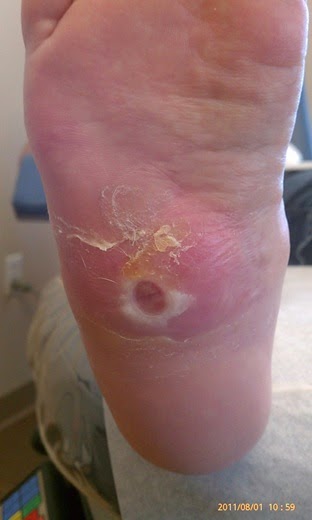
ICD-10 Coding for Diabetic wounds, what you as a podiatrist should know.

We are now a 2 full months into the ICD-10 code take over.  In my own practice, I can tell you that my world did not come crumbling down, and claims from all payers are coming in the normal standard fashion.  All of my at risk foot care or diabetic foot care claims have all been clean with no problems. Normal every day tendon injuries like peroneal tendonitis, Achilles tendonitis, posterior tibial tendonitis and plantar fasciitis claims are going through as well with no problems.

The only claims that I had kicked back to me have been my diabetic foot ulcers.  The following is what you need to know to bill a diabetic foot wound correctly:

1.  You will need the diabetic foot code associated with if the person is Type 1 or Type 2 diabetic and has a foot wound

  • E11.621- Type 2 diabetes with foot ulcer
  • E10.621- Type 1 diabetes with foot ulcer
2.  You will need the code for the specificity of the site, laterality, and depth.  L97.5 is a non pressure wound other part of the foot(toes) and L97.4 is a non pressure wound on the heel or midfoot adding a 1 or 2 gives the laterality, right or left foot respectively. But the addition of depth is included in the codes below to give you the most specificity for these codes to be covered and paid. 

If your wound is on the right side you will be using one of the codes below for a diabetic foot wound on the toes:
  • L97.511-  Right foot non pressure ulcer with breakdown of skin
  • L97.512-  Right foot non pressure ulcer with fat layer exposed
  • L97.513-  Right foot non pressure ulcer with necrosis of muscle
  • L97.514-  Right foot non pressure ulcer with necrosis of bone


If your wound is on the left side you will be using one of the codes below for a diabetic foot wound on the toes:
  • L97.521-  Left foot non pressure ulcer with breakdown of skin
  • L97.522-  Left foot non pressure ulcer with fat layer exposed
  • L97.523-  Left foot non pressure ulcer with necrosis of muscle
  • L97.524-  Left foot non pressure ulcer with necrosis of bone
If your wound is on the right side you will be using one of the codes below for a diabetic foot wound on the heel or midfoot:
  • L97.411-  Right foot non pressure ulcer with breakdown of skin
  • L97.412-  Right foot non pressure ulcer with fat layer exposed
  • L97.413-  Right foot non pressure ulcer with necrosis of muscle
  • L97.414-  Right foot non pressure ulcer with necrosis of bone
If your wound is on the left side you will be using one of the codes below for a diabetic foot wound on the heel or midfoot:
  • L97.421-  Left foot non pressure ulcer with breakdown of skin
  • L97.422-  Left foot non pressure ulcer with fat layer exposed
  • L97.423-  Left foot non pressure ulcer with necrosis of muscle
  • L97.424-  Left foot non pressure ulcer with necrosis of bone
3.  Most of our diabetic patients that have foot ulcers also have some degree of polyneuropathy and coding for that would get you to the highest level of specificity using one of the following codes linking the Type 1 or 2 diabetes with the polyneuropathy:

  • E11.42- Type 2 diabetes with diabetic polyneuropathy
  • E10.42- Type 1 diabetes with diabetic polyneuropathy
For example, from the information above, if you had a Type 2 diabetic with a foot ulcer on their left heel with exposed bone and they have polyneuropathy the only three codes you need to be reimbursed with the correct documentation, would be the following:
  • E11.621
  • L97.424
  • E11.42
This again is pretty simple when you have it all in front of you and organized, As it is almost impossible to have all of these codes on your superbill or encounter form, it may be a great idea to have these codes on a cheat sheet in each treatment room.  It will save you time, not having to scroll through your EMR for the codes, especially of you see high volume of diabetic wounds. 

I hope this helps makes your life a little easier in the ICD-10 new world of billing. I know in my practice I see a lot of diabetic wounds so I was happy to see these codes were not terribly convoluted. If you do not have a "superbill" we have a quick reference sheet, for what we see as podiatrist most common diagnosis, available at our website. For $75 we will email it to you with our metatarsal fracture cheat sheet and our power point on billing diabetic foot care. Our website is listed here   http://centeranklefootcare.com/catalog/c14_p1.html
this is an editable rtf and pdf format.

Good luck with your billing!

Michele McGowan, DPM


Friday, September 11, 2015

Plantar fasciitis and ICD10 coding, what do you need to know?

This is an easy one, you just need to know the new ICD-10 code from the old ICD-9 code.  The plantar fasciitis, much to my surprise, does not have laterality.  So the old plantar fasciitis ICD-9 code was 728.71 and now is M72.2.

I'm guessing that when ICD-11 hits this will change, but for now it is a pretty simple and straightforward conversion.

So a new patient with right foot plantar fasciitis would look like this:

ICD-10 Diagnosis codes:
M72.2       Plantar fasciitis
M79.604   Pain in limb right limb
M77.31     Heel spur right calcaneus(if on x-ray there is a spur and you dictate it, I would recommend this code as well.)  Being as specific as possible is going to be very important in ICD-10. The M77.31 specifies laterally for right side and the code for left heel spur is M77.32.

CPT procedure codes for this patient would be:
99203       If you have documented well and spent the appropriate amount of time with the patient you have a new patient encounter of this level.
73630 R   If you are taking X-rays in office to rule out stress fracture or evaluate possible heel spur, this is the 3 views of the foot with the appropriate right sided modifier.  But this is where we see our laterally with plantar fasciitis in the x-rays.

I hope this helps makes your life a little easier in the ICD-10 new world of billing. I know in my practice I see a ton of plantar fasciitis, so I was happy to see these codes were not terribly convoluted. If you do not have a "superbill" we have a quick reference sheet, for what we see as podiatrist most common diagnosis, available at our website at http://centeranklefootcare.com/catalog/c14_p1.html
this is an editable rtf and pdf format.

Good luck with your billing!

Michele McGowan, DPM

Thursday, September 10, 2015

If you are a podiatrist, you treat diabetic feet......It's what you do! Know the ICD-10 codes you need to know for treating your diabetic patients.


 •Many people getting lost in the trauma coding but unless you are in a very high trauma practice, these should not be your main focus.
•Don’t get distracted by the coders who can’t pronounce calcaneus•Know your most common procedures and know how to code them
At risk foot care•Billing 11721•You need to document your class finds and have your Q modifiers correct•Diagnosis needed:•Must have diabetes diagnosis•Choices:•E11.40 DM2 Neuro Comp•E11.51 DM2 PVD Comp•E10.40 DM1 Neuro Comp•E10.51 DM1 PVD Comp•Must have Nail pathology
•B35.1 Mycotic Nail•If Neuro Modifier being used the DM diagnosis had it but would consider using G60.9 which is peripheral Neuropath
   Mycotic diabetic foot care for DM type 2 with neuro might look like
•Procedure code: 11721 Q8•Diagnosis codes:
•E11.40•B35.1•G60.9•Procedure Codes: 11055,11056 Q8•Diagnosis codes:
•E11.40•B35.1•G60.9•L84


Mycotic diabetic foot care for DM type 2 with neuro might look like
    Procedure code: 11721 Q
    •Diagnosis codes:
•E11.51
•B35.1
•I73.9

•Procedure Codes: 11055,11056 Q9
•Diagnosis codes:
•E11.51
•B35.1
•I73.9
•L84

Mycotic diabetic foot care for DMtype1 with neuro might look like
•Procedure code: 11721 Q8
•Diagnosis codes:
•E10.40
•B35.1
•G60.9

•Procedure Codes: 11055,11056 Q8
•Diagnosis codes:
•E10.40
•B35.1
•G60.9
•L84

Mycotic diabetic foot care for DM type1 with PVD might look like
•Procedure code: 11721 Q9
•Diagnosis codes:
•E10.51
•B35.1
•I73.9

•Procedure Codes: 11055,11056 Q9
•Diagnosis codes:
•E10.51
•B35.1
•I73.9
•L84

•If you are a practicing podiatrist seeing diabetic patients can decrease the possibility of them having a non traumatic amputation tremendously
•In the study by Weck, et al, in Cardiovascular Diabetology, 2013. Instituting a structured diabetic foot program can yield a 75% reduction in amputation rates and a near four-fold reduction in inpatient mortality.
•It has been proven time and time again in peer reviewed literature, that these patients who have diabetes that visit the podiatrist are much less likely to have an amputation of an extremity. 
• Podiatric medical care in people with history of diabetic foot ulcers can reduce the high level amputation between 65% and 80%. Gibson, et al, Int Wound Journal 2013. 
Ulcer diagnosis in diabetics
•If your patient is Type 1 diabetic with an ulcer the diagnosis code is:  E10.622
•If your patient is Type 2 diabetic with an ulcer the diagnosis code is: E11.622
•These codes are the highest level of specificity for the types of Diabetic Ulcers we see in the office (do not confuse with pressure ulcers, different codes)
•This is a good improvement, as all of the ulcer codes used to be jumbled together whether they were pressure, diabetic ect.
•Coding for Diabetic Foot Ulcer debridement
•11042, 11043 and 11042 use modifier L or R
•There is no laterally in the diabetic ulcer codes themselves so laterally is still in your procedure codes
•Diagnosis: 
•E11.621 Type 2 dm with foot/ankle ulcer
•E10.622 Type 1 dm with foot/ankle ulcer

•To be specific as possible I would consider also coding their diabetes
•Choices:
•E11.40 DM2 Neuro Comp
•E11.51 DM2 PVD Comp
•E10.40 DM1 Neuro Comp
•E10.51 DM1 PVD Comp

•Yes they have diabetes and an ulcer. But documenting the DM2 Neuro E11.40, for example, is letting them know that the diagnosis of ulcer is “due to” the Neuro Complications
•This makes this much more specific


Check out our website at: http://centeranklefootcare.com/catalog/c14_p1.html for a superbill for podiatry most common codes

Tuesday, September 8, 2015

ICD-10 It is almost here! What podiatrist need to keep in mind-don't lose yourself in the details!

The October 1st deadline is quickly approaching for ICD-10.  Of course the question we are all asking is- "am I ready?"  But the follow up questions are, "is my staff?", "is my billing company?", "is my coding person?"  The reality is none of us truly know.  Insurance companies have the upper hand on this one.  We can only try our best to be prepared but the absolute word of caution I have for you is, do not rely on anyone else other than yourself to know what you need to know.  As a podiatrist, you know you have to be a little more scrappy than the other specialties.  We know modifiers, as we have the craziest modifiers and are a modifier specialty in our procedure codes.  So you should not fear the new diagnosis codes that are followed by: A D G S for the trauma fracture codes for example.

After one week of billing you will remember easily that when seeing fractures these letters will trail your diagnosis:
  • A, Initial encounter for closed fracture
  • B, Initial encounter for open fracture
  • D, Subsequent encounter for fracture with routine healing
  • G, Subsequent encounter for fracture with delayed healing
I have struggled to the level of specificity that is truly needed for your claim to be considered clean.  If you bill 73630 for example, for x-rays right side for a right foot 2nd metatarsal fracture non-displaced, the exact code is S92.324A.  There is also a code of S92.301A that is fracture of metatarsal closed right foot that would most likely get this claimed covered for you as well, but none of us are exactly sure yet. On my superbill I did not included every fracture of every bone.  My recommendation is to have a cheat sheet for fractures of metatarsals laminated and put in your office and at every desk in your office where staff members sit. We have this cheat sheet available and included with our Podiatry specific ICD-10 Superbill.  This is available at our website at: http://centeranklefootcare.com/catalog/c14_p1.html

But at the end of the day, what you need to make sure you know how to bill inside and out is your most common diagnosis with your most common procedures.  Sure I see trauma, but I see a lot of plantar fasciitis, posterior tibial tendonitis, peroneal tendonitis, ankle sprains, ulcers and diabetic foot care.  I will tell you that these are clear and very straightforward for the most part in ICD10. We are all in this together and should not be overwhelmed by the bean counters. 

Good luck as October 1st, 2015 nears closer!

Michele McGowan, DPM

Monday, September 7, 2015

Are you frustrated with impending ICD-10 quickly approaching? We have made it a little easier for other podiatrists!


If you have not yet put together a Superbill to make it easier for yourself or your staff you may want to check out ours.  We have put together the 50 plus most common codes used by podiatrists, because we are podiatrists this was the easy part.  The hard part was converting each code to the level of specificity needed for ICD-10.  There are many mumbling conversations where people are excited to not have to code perfect for the beginning of the ICD-10 transition, but our specialty of podiatry is so specific, why not do it right from the start?

We have available a customization format where will email you a word, rtf and pdf  format.  The superbill has the most common podiatry diagnosis and the most common podiatry procedure codes.  It is an excellent way to keep you and your staff from going crazy trying to convert on the fly.  You may need to change some codes if some of the codes change, but this will be easy as you will have the master copy!


This Superbill is available on our website at : http://www.centeranklefootcare.com/catalog/c14_p1.html 

Below are just some of the podiatry specific diagnosis on our superbill that is pictured above but with the specific detail needed.
  • abscess  toe
  • hallux valgus
  • hammer toe
  • achilles tendonitis
  • tarsal tunnel
  • diabetic foot care codes
  • plantar fasciitis
  • ankle sprain
  • ulcers
  • and much more 
Good luck to everyone as you prepare for this next journey in healthcare!